How to Draw Banners. Drawing banners made easy! Learn the basics, six popular styles, and follow along with a video tutorial.
How to Draw Banners (Step-by-Step + 6 Easy Styles)
Banners are one of those magical drawing elements that instantly make your lettering and illustrations feel finished. They’re perfect for holding quotes, names, dates, or little messages. Once you know the basics, you can customize them endlessly.
In this post, I’ll walk you through how to draw banners step by step, break down six of the most common banner styles, and share a video tutorial you can follow along with. If you’re working digitally, I’ll also show you how to speed things up with my new Hand-Drawn Banners Procreate Stamp Kit.
Whether you’re sketching on paper or drawing in Procreate, banners are an illustration you’ll use again and again in your lettering work
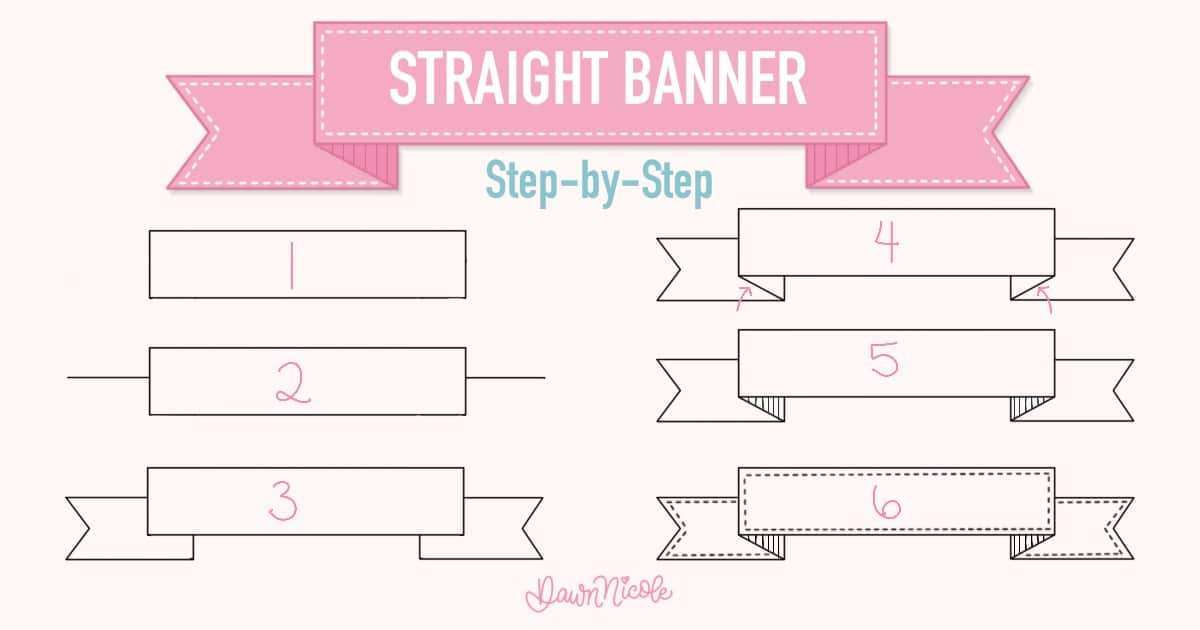
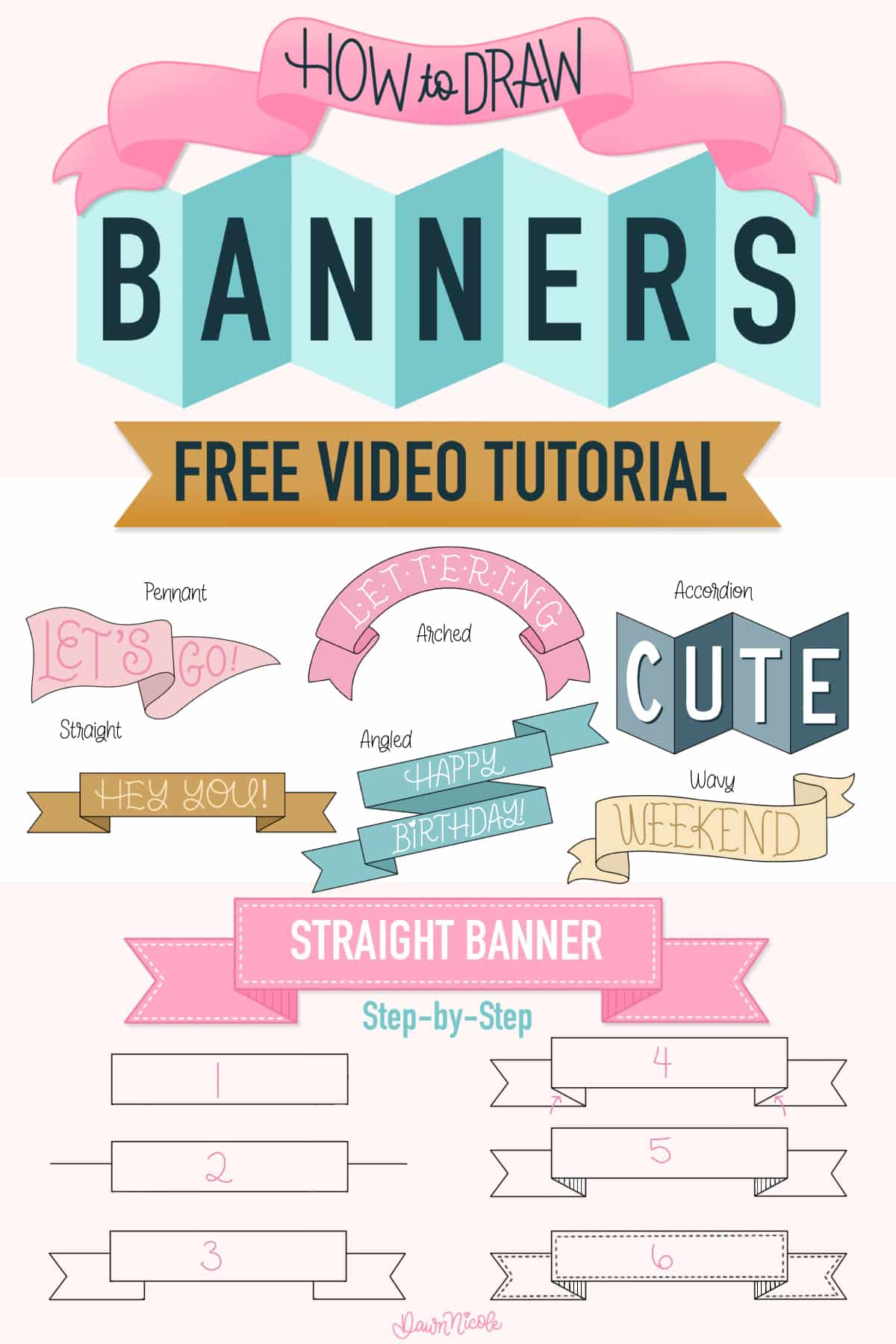
Basic Steps for Drawing Any Banner
No matter which banner style you’re drawing, the foundation is the same. Start simple and build from there.
- Draw the main shape. This is the long, rectangular, or ribbon-like shape that will hold your text. Keep it loose—perfect symmetry isn’t required, especially if you want a hand-drawn aesthetic.
- Add the folds and tails. Extend lines from the sides or ends to create ribbon tails, overlaps, or folded edges.
- Define depth. Add inner lines where the banner folds back on itself. This creates dimension and makes the banner feel more realistic.
- Clean up your lines. Erase or refine overlapping sketch lines so the banner reads clearly.
- Add lettering and details. Once the banner shape is done, add your text, shading, texture, or embellishments.
LETTERING ON BANNERS
In the video tutorial linked near the end of this blog post, I’ll show you how to add lettering to your banners so it looks balanced and intentional. No wonky lettering here! We’ll cover a few simple guidelines that make a big difference, especially when lettering on arcs, waves, and angles. Below is a visual example of what I’ll demonstrate in the lesson.
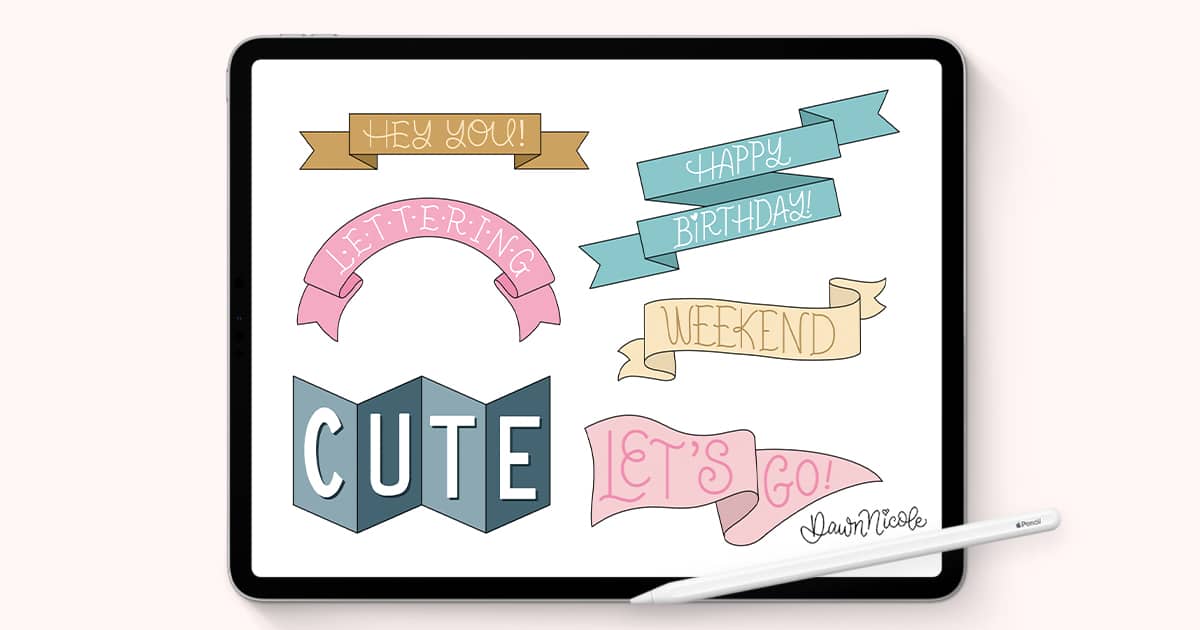
The 6 Main Types of Banners
These six banner styles cover the most common of what you’ll see in lettering, illustration, and design, and they’re all beginner-friendly.
Straight Banners
Straight banners are the simplest and most versatile style. They work great for clean lettering layouts, logos, and labels.
Best for: Names and titles, Minimal designs, Beginner practice
Angled Banners
Angled banners tilt upward or downward, adding instant movement and energy to your design.
Best for: Emphasis, Dynamic compositions, Retro or bold styles
Wavy Banners
Wavy banners curve gently up and down, giving a softer, more playful feel.
Best for: Quotes, Whimsical or feminine designs, Hand-lettered projects
Arched Banners
Arched banners curve into a smooth rainbow shape. They’re perfect for wrapping text around a focal point.
Best for: Circular layouts, Badges and emblems, Top or bottom text placement
Accordion Banners
Accordion banners fold back and forth like paper fans. They look more detailed but are easier than they seem once you break them into sections.
Best for: Vintage styles, Decorative lettering, Statement designs
PENNANT Banners
Pennant banners are made up of triangular or flag-shaped pieces. They can be strung together or used alone. They feel festive, fun, and slightly retro. Pennants work especially well when each triangle holds a single letter, making them great for names, dates, or bold statements.
Best for: Playful Styles, Collegiate/Sports, Celebrations, Parties, Retro Designs
Watch the Video Tutorial
This lesson is about 30 minutes long.
Speed Things Up in Procreate
If you love drawing banners but don’t want to redraw them from scratch every time, I made something just for you.
My Hand-Drawn Banners Procreate Stamp Kit includes a collection of ready-to-use banner stamps in multiple styles. You can resize, warp, add your own lettering, or use them as a starting point for custom designs. There are 35 banner stamps and one detail monoline brush.
Perfect for:
- Lettering projects
- Creating Digital planners, printables, headers, and labels
- Client work and quick layouts
Hand-Drawn Banner Procreate Stamp Kit →
FAQ — How to Draw Banners
How do you draw a banner step by step?
Start with the main banner shape — usually a rectangle or long strip — then add ribbon ends or tails on each side. Draw fold lines where the ribbon bends, add edge thickness, and finish with shading to create depth.
What is the easiest banner to draw for beginners?
A straight ribbon banner with pointed ends is the easiest style. It uses simple straight lines and small triangular tails, making it perfect for beginners practicing basic banner structure.
What shapes are banners made from?
Most banners are built from rectangles, long strips, triangles (for ribbon tails), and curved lines for wavy ribbon styles. Breaking banners into simple shapes makes them much easier to draw accurately.
How do you make a banner look 3D?
Add fold lines, draw the underside of ribbon turns, and include light shading behind overlaps. Showing which parts sit in front and which fold under creates a three-dimensional look.
How do you draw curved or wavy banners?
Sketch a gentle S-curve or arc first, then draw parallel lines to create ribbon width. Add folds where the ribbon changes direction and attach ribbon tails at the ends.
Should you draw the text or the banner first?
Either works, but many artists lightly sketch the text first so they can size the banner to fit the lettering. This helps with spacing and keeps the final layout balanced.
How do you center text inside a banner?
Lightly mark the banner’s center point and work outward when lettering. You can also count letters and spacing ahead of time to keep the design visually balanced.
What tools are best for drawing banners?
A pencil and eraser are ideal for sketching. Ink pens or brush pens work well for final outlines. In digital formats, any drawing app with layers and guides can help refine banner shapes.
What are common mistakes when drawing banners?
Common mistakes include uneven ribbon width, folds that don’t line up, tails that point in inconsistent directions, and missing underside lines where the ribbon turns.
How can I practice drawing banners faster?
Practice drawing small banner variations repeatedly — straight, curved, folded, and layered styles. Quick daily drills help build muscle memory and cleaner line control.
What are banners used for in art and lettering?
Banners are often used to highlight words or phrases in hand lettering, logos, posters, cards, journal pages, and decorative illustrations.
 WANT MORE DRAWING IDEAS?
 WANT MORE DRAWING IDEAS?
This list of 150+ drawing ideas includes letters, flowers, bookish doodles, seasonal sketches, and more!
Final Thoughts
Banners are one of those drawing skills that unlock so many creative possibilities. Once you understand the basic structure, you can mix styles, exaggerate shapes, and make them completely your own.
Practice a few of these banner types, watch the video tutorial, and don’t forget that you can always use stamps as a shortcut when you want speed and style.
Happy drawing!
.